
Crack Filling and Sealing in Lake Hallie
Crack Filling and Sealing in Lake Hallie, Wisconsin.
Hot rubber crack filling for driveways and lots in Lake Hallie, before the freeze does the expensive part.
About 10 minutes from Eau Claire. Free estimates, and a straight read on whether it needs doing yet.
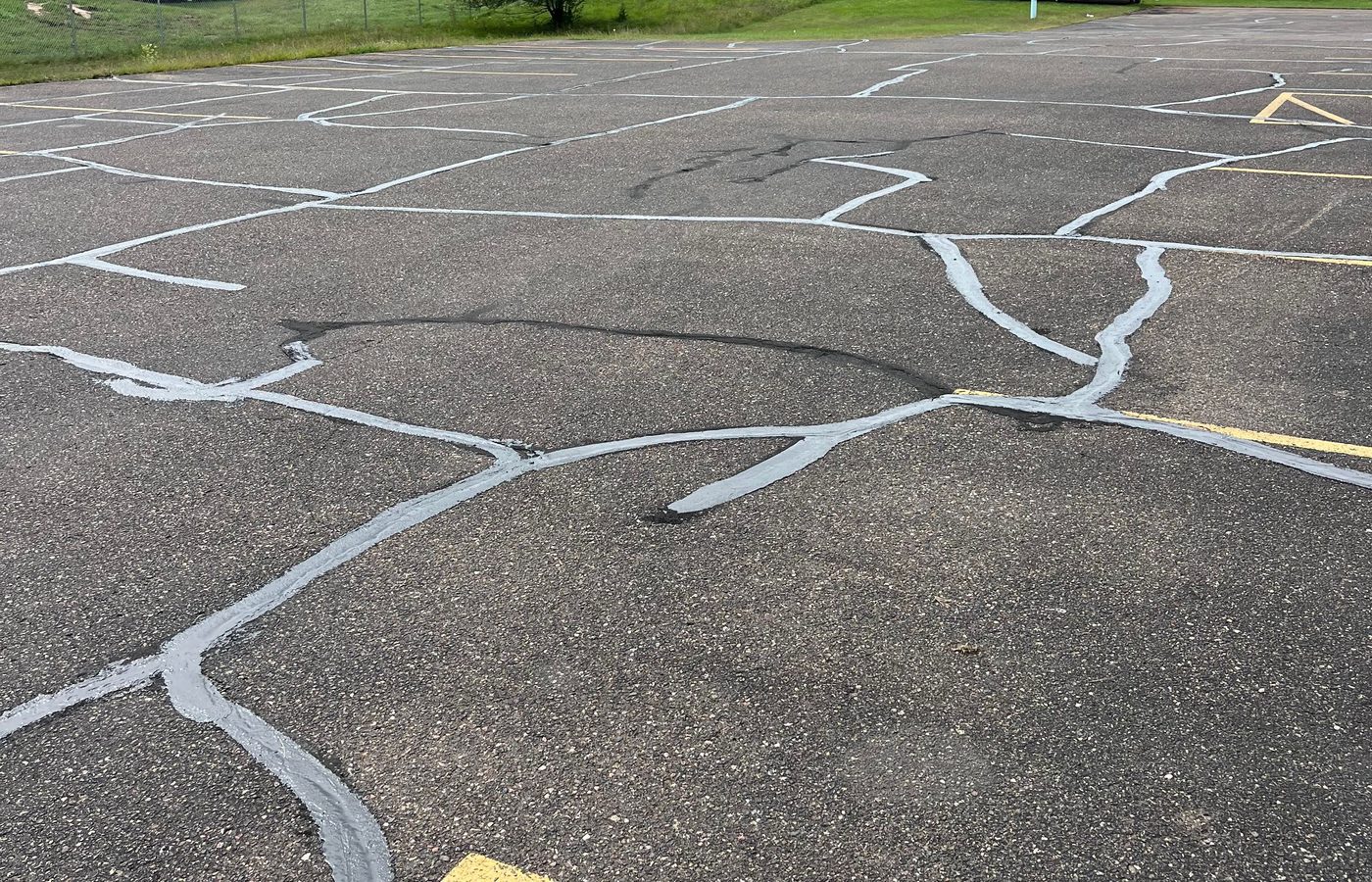
What a Crack Filling and Sealing Job Looks Like in Lake Hallie
Lake Hallie is the clearest example in the whole area of a town hitting a maintenance milestone together. A driveway laid in 2004 has now been through twenty winters. If it has never been sealed, the surface is spent but the base underneath is almost certainly sound, because it was built to a modern subdivision standard rather than thrown down in the 1950s.
That's the best-value job in this trade, and there are hundreds of them here. It is also why we would rather quote a whole street than one drive: neighbors on a 2000s cul-de-sac are usually all due in the same season, and doing several at once takes the trip cost out of each one.
Crack Filling and Sealing specifically in Lake Hallie
Twenty-year-old subdivision drives crack at predictable places: the cold joint down the middle where the paver made two passes, and the edges where the asphalt has nothing holding it. Hot rubber into those now, before the first winter opens them properly, is the cheapest work in this trade. Sandy river-valley subgrade is the reason it matters more here than the crack's width suggests, because once water is through the surface it moves rather than sits.
The Driveways and Lots in Lake Hallie
Lake Hallie sits between Eau Claire and Chippewa Falls at the junction of US 53 and Highway 29, with the Chippewa River along its western edge and the regional airport on its southern border. The lake itself is an oxbow, a piece of the river's old course. The village only incorporated in 2003, which is why so much of it feels, and is, new.
The most suburban stock in the valley and the youngest. Over 42 percent of Lake Hallie's housing was built in 2000 or later, the single largest cohort being the 2000s at just under a quarter of everything. Fewer than four percent predates 1940.
It's also overwhelmingly detached single family, close to 69 percent, with almost no large apartment stock. What that means on the ground is a town full of wide, modern, two-and-three-car driveways that were all poured within a few years of each other and are now arriving at the same decision at the same time.
Lake Hallie
We work the whole village rather than a named handful of neighborhoods.
Around Lake Hallie: Hallie Ball Park, Peace Memorial Park, Old Abe State Trail, Lake Hallie, Chippewa Valley Regional Airport.
Same freeze and 48-inch footing regime as the neighboring cities. The village sits on Chippewa River valley outwash, so the ground drains quickly, and the newer subdivisions were generally graded properly when they were built.
From our jobs
Job Photos
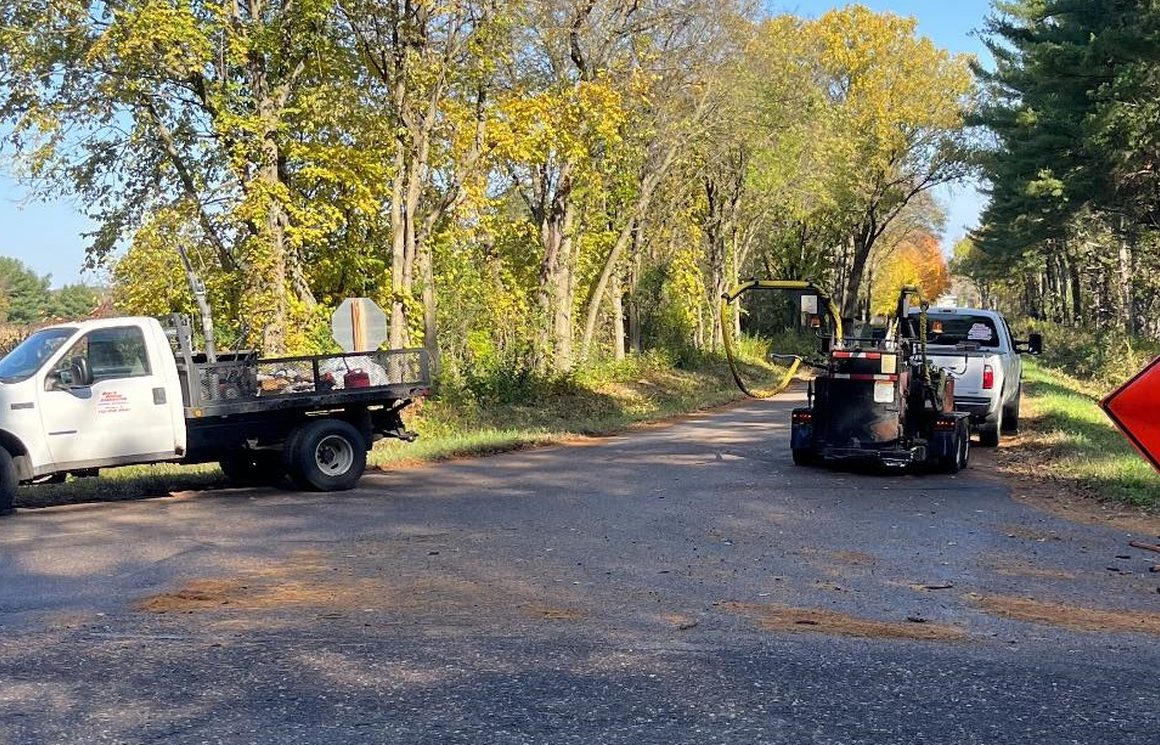
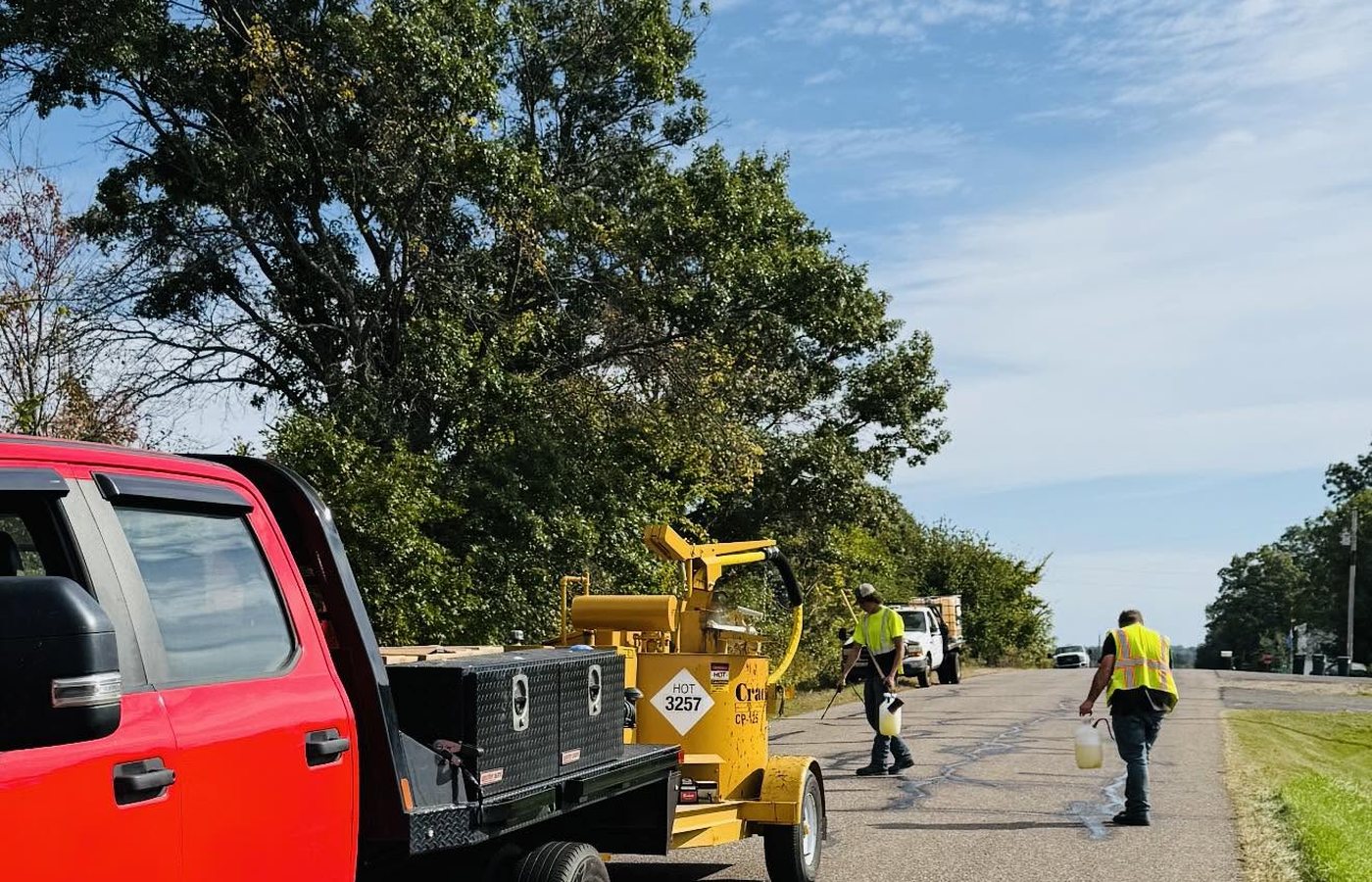
Hot rubber vs. cold pour
The stuff in a jug at the hardware store is cold pour. It goes in as a liquid, dries, shrinks, and sits in the crack like a rubber band laid in a trench. It's not bonded to anything. The first hard freeze pulls the crack open, the filler has nothing holding it to the walls, and it lifts out in a strip. Most people have seen this happen and assumed it was a bad batch. Hot-applied rubber goes in at around 400 degrees. At that temperature it's thin enough to run down into the crack instead of bridging it, and hot enough to melt into the asphalt faces on either side. When it cools it has bonded to the walls of the crack, so when the crack moves, the filler moves with it.
Cold pour
The jug from the hardware store, and what a cheap quote uses
- Sits in the crack rather than bonding to it
- Shrinks as it cures, leaving a channel down the middle
- Pulls out in strips after the first hard winter
- Cheap enough that it gets redone every year, which isn't cheap
Hot-applied rubber
What comes off our kettle
- Flows to the bottom of the crack at 400 degrees
- Melts into the asphalt faces and bonds to both walls
- Stays flexible, so it moves when the crack moves
- Holds for years, not for one season
This is the one place where the cheaper option isn't a smaller version of the right one. It's a different product doing a different thing.
What Decides the Price in Lake Hallie
Priced by the foot of crack, not by the area of the surface, because that's what actually drives the work. Usually done as part of a sealcoating job, where it costs less than it would on its own.
With a sealcoat job
Driveway
Measured on site
- Most driveways need some, and it's included up to a point
- Heavy cracking is quoted separately and said up front
Crack filling alone
Driveway, no sealcoat
Measured on site
- Worth doing on its own if the surface is otherwise sound
Commercial lot
Per linear foot
Measured on site
- Depends on crack width, depth and how much routing it needs
- Most lots are quoted as a lump sum after a walk
Cracks wider than about an inch and a half, or ones that have broken into a network, are past filling. Those get cut out and patched rather than filled with something that will not hold.
How the Work Goes in Lake Hallie
Done before sealer, always: sealer can't bridge an open crack.
Clean the crack out
Blown out with compressed air, vegetation and old failed filler removed. Rubber won't bond to dirt any more than sealer will.
Rout the wide ones
Wide or heavily worked cracks get cut to a consistent reservoir so the filler has a proper shape to sit in. Not every crack needs it; the ones that do are the ones that have already failed once.
Fill hot
Direct-fire kettle, rubber at 400 degrees, wanded into the crack until it's full from the bottom up rather than skinned over at the top.
Squeegee and let it set
Struck off flush or slightly banded over, depending on the surface. Sets hard enough to drive on in under an hour in most conditions.
Questions We Get in Lake Hallie
What Lake Hallie calls us about, answered straight.
More questions answeredOur driveway went in when the subdivision was built around 2005. What does it need?
Several of us on the street want ours done. Is there a discount?
There's a crack straight down the middle of our driveway. Is that a defect?
Is our village drive different from one in Chippewa Falls or Eau Claire?
How much does crack filling cost?
Why does the temperature of the crack filler matter?
Should I fill cracks before sealcoating or after?
Is there a crack too big to fill?
When is the best time of year for crack filling?
Get a Free Estimate in Lake Hallie
Tell us what it looks like and we'll come measure it. You get a written price before anything starts.
(715) 450-9897- Free on driveways and lots anywhere in the service area
- A photo of the problem helps, and it can go in the message
- Surfaces that are not ready yet get told so at the estimate
Get an estimate
Send the form and we'll call you back. The estimate is free.
Other Work We Do in Lake Hallie
- Sealcoating in Lake Hallie
- Asphalt Repair and Patching in Lake Hallie
- Catch Basin Repair in Lake Hallie
- Parking Lot Striping in Lake Hallie
- Track and Athletic Surfaces in Lake Hallie
- Concrete in Lake Hallie
- Asphalt Paving in Lake Hallie
- Commercial Snow Removal in Lake Hallie
Crack Filling and Sealing in Nearby Towns
- Crack Filling and Sealing in Chippewa Falls
- Crack Filling and Sealing in Altoona
- Crack Filling and Sealing in Eau Claire
- Crack Filling and Sealing in Fall Creek
- Crack Filling and Sealing in Elk Mound
- Crack Filling and Sealing in Cadott
Everything about crack filling and sealing, including how the work goes and what changes the price